
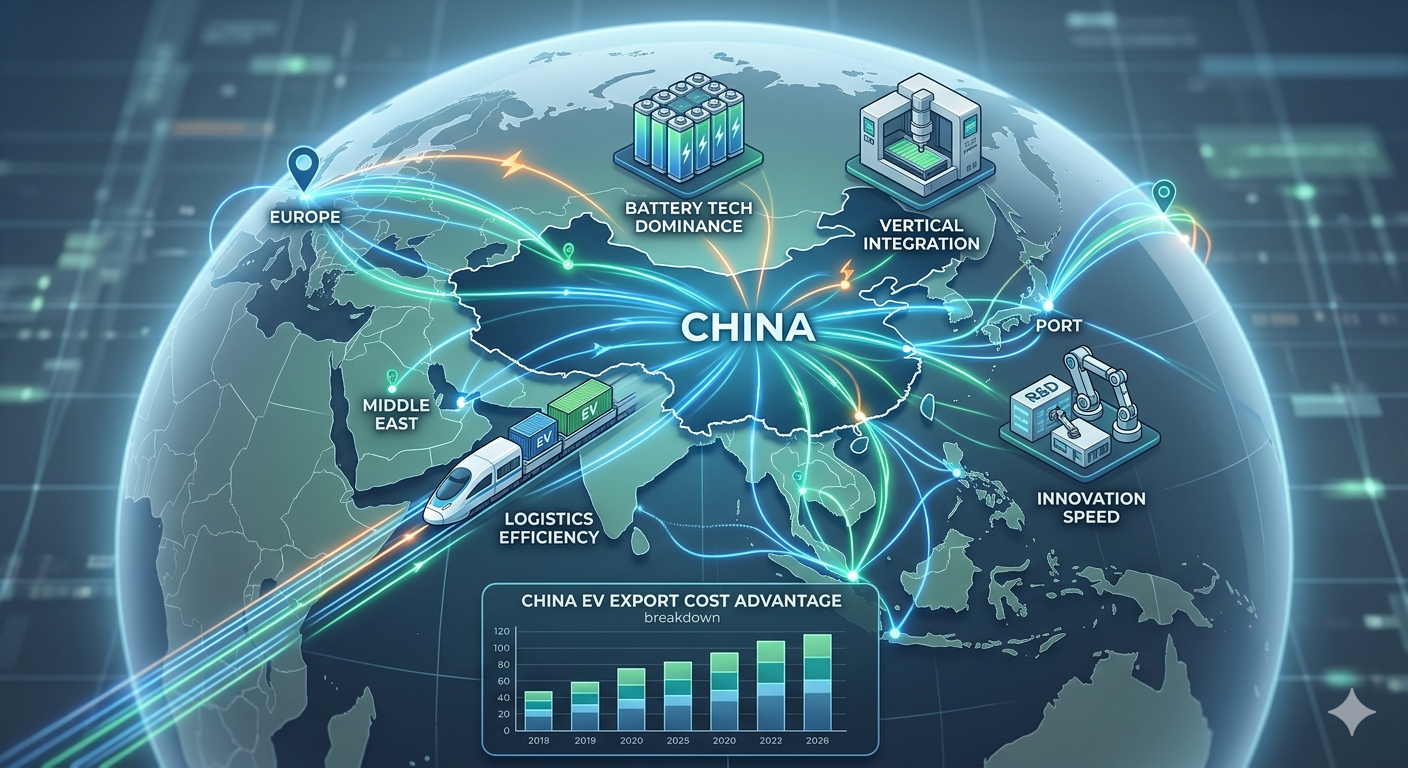
The global automotive industry isn’t just evolving—it’s being fundamentally reorganized.
While legacy manufacturers in the U.S., Europe, and Japan continue navigating electrification challenges, Chinese EV makers are scaling globally at a pace few expected. In markets across the Middle East, Southeast Asia, and Latin America, Chinese electric vehicles are no longer the “low-cost alternative”—they are increasingly the default choice.
A common narrative attributes this rise to subsidies or labor costs. That explanation misses the real story.
At ChinaEVExports Insights, our analysis points to a deeper structural shift:
China has built a self-contained, vertically integrated EV supply chain that operates with a level of efficiency the traditional global model cannot match.
1. Vertical Integration at Scale: Why BYD Changed the Rules
One of the clearest examples of this transformation is BYD’s operating model.
Traditional automakers rely on a fragmented supplier network—often spread across multiple continents. Chinese EV leaders, by contrast, have moved aggressively toward controlling core components in-house.
What this looks like in practice:
- Batteries are no longer outsourced—they are designed and manufactured internally
- Power semiconductors are increasingly developed in-house
- Key components, from motors to electronic systems, are produced within tightly coordinated ecosystems
The result is not just cost savings—it’s control.
This model reduces dependency on external suppliers, shortens production cycles, and allows manufacturers to respond quickly to both market demand and technical challenges.
In a volatile global supply environment, that level of control has become a decisive advantage.
2. Battery Dominance: Control Starts Upstream
Battery cost and availability remain the single most important factors in EV competitiveness. China’s position here extends far beyond manufacturing.
Upstream Advantage
Chinese companies dominate the refining and processing of critical battery materials:
- Lithium refining capacity: majority global share
- Cobalt processing: industry-leading control
- Graphite production: near-total dominance
This upstream integration shields Chinese EV makers from price volatility and supply disruptions that continue to impact Western competitors.
LFP Strategy: A Practical Bet That Paid Off
While many Western OEMs focused on nickel-based chemistries, China accelerated development and deployment of LFP (Lithium Iron Phosphate) batteries.
Today, LFP powers a large share of Chinese EV exports—and for good reason:
- Lower production cost
- Improved safety and thermal stability
- Longer lifecycle performance
For emerging markets where price sensitivity is high, LFP has become a key enabler of rapid EV adoption.
3. Speed as a Competitive Weapon: From “Auto Industry” to “Tech Industry”
Perhaps the most underestimated advantage is development speed.
Traditional vehicle development cycles often span 4 to 6 years. In China, that timeline has been compressed dramatically—sometimes to under two years.
This isn’t just about working faster. It’s about working differently.
Chinese EV companies increasingly operate with a mindset closer to consumer electronics:
- Features evolve continuously through OTA updates
- Hardware improvements are rolled out in shorter cycles
- Supplier proximity enables rapid prototyping and iteration
In manufacturing hubs like the Yangtze River Delta, suppliers are often located within hours—not weeks—of OEM facilities. This proximity creates a feedback loop that accelerates innovation in ways global supply chains struggle to replicate.
4. What This Means for Global Importers and Dealers
For buyers sourcing vehicles through platforms like ChinaEVExports, these structural advantages translate into clear commercial benefits:
More Competitive Pricing
A tightly integrated supply chain reduces redundant costs across production, logistics, and procurement.
Faster Technology Cycles
Vehicles entering export markets are often already on their third or fourth iteration—refined through rapid domestic deployment.
Supply Chain Stability
In a period defined by geopolitical uncertainty, a localized ecosystem can offer more predictable delivery timelines than globally fragmented alternatives.
5. Outlook: 2024–2030
The global EV race is no longer just about brand or design—it’s about systems.
China’s EV ecosystem has reached a level of maturity where its advantages are structural, not temporary. While trade policies and tariffs may influence regional access, they do not fundamentally change the underlying cost and speed advantages.
Looking ahead, several trends are likely:
- Continued expansion into emerging markets
- Increasing acceptance of Chinese brands in developed markets
- Further cost reductions driven by scale and integration
The gap between Chinese EV manufacturers and traditional automakers is not simply a matter of time—it is rooted in fundamentally different industrial models.
Final Takeaway
Understanding China’s EV rise requires looking beyond surface-level explanations.
This is not just a story of cheaper production—it’s a story of system-level efficiency, where supply chain design, speed of execution, and vertical integration work together to create a durable global advantage.
For businesses involved in EV importing, distribution, or market entry, recognizing this shift is no longer optional—it’s essential.