
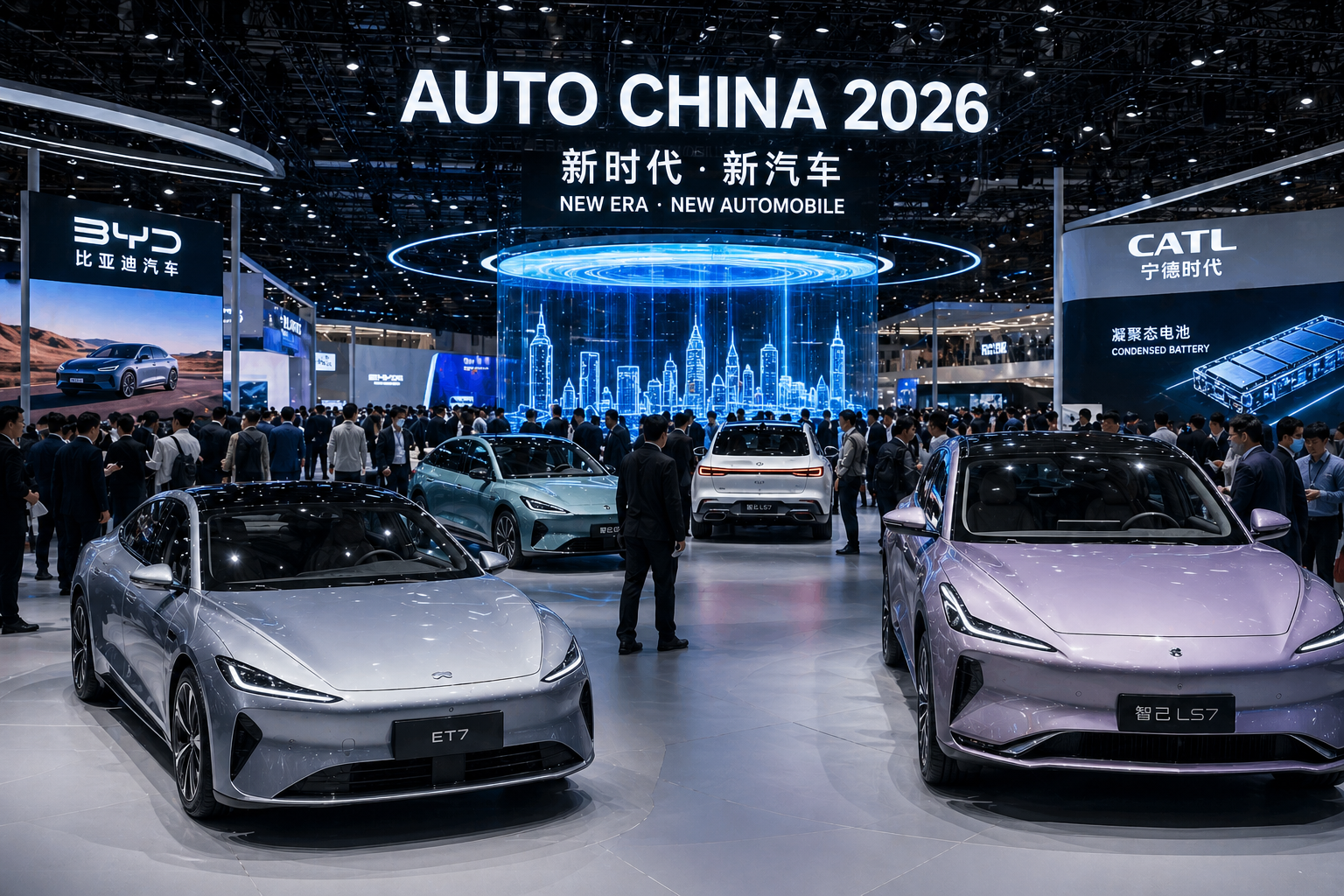
Introduction: Setting the Stage for Auto China 2026
Beijing, April 2026 — Walking into the halls of Auto China this year, one thing becomes immediately clear: the center of gravity in the global automotive industry has shifted.
Unlike previous editions that focused on single-technology breakthroughs, Auto China 2026 feels more like a systems showcase. Batteries, autonomous driving, AI, and global expansion strategies are no longer presented as separate pillars—they are deeply intertwined.
Two years ago, the conversation was dominated by 800V fast charging and the arrival of new entrants from the consumer electronics world. Today, the tone is different. The industry is no longer asking what is possible, but rather what is scalable, exportable, and defensible at a global level.
At https://chinaevexports.com/, our on-the-ground observations suggest that Auto China 2026 is less about concept vehicles—and more about technologies that are approaching real deployment across global markets.
Technology on Display: Solid-State Batteries Edge Closer to Reality
Battery innovation remains one of the biggest crowd-pullers at the show, but the narrative has clearly matured.
Several major OEMs and battery suppliers are now showcasing semi-solid and early-stage solid-state battery systems not as distant concepts, but as part of near-term product roadmaps. Compared to 2024, where most discussions stayed at the prototype level, this year’s exhibits are noticeably more grounded in manufacturability.
Across multiple booths, a few themes repeat:
- Target ranges moving beyond 1,000 km (CLTC)
- Fast-charging demonstrations emphasizing real-world usability rather than peak lab numbers
- Increased focus on safety stability under extreme conditions
What stands out is the shift in messaging. Instead of chasing headline numbers alone, companies are framing battery technology as part of a broader reliability and lifecycle narrative—something that resonates more strongly with overseas markets.
For global buyers and importers, this is a meaningful signal: the industry may be approaching the point where battery concerns become less of a barrier in cross-border adoption.
Autonomous Driving: From Feature Showcase to Deployment Roadmaps
Autonomous driving zones are among the busiest areas at Auto China 2026, but the tone here is also changing.
In 2024, much of the focus was on demonstrating capabilities—urban NOA, highway automation, and sensor hardware stacks. This year, the conversation is noticeably more pragmatic.
Manufacturers are now presenting clear rollout strategies:
- Level 3 functions positioned for broader release across mid-to-high-end vehicles
- Level 4 systems demonstrated within geofenced urban or logistics scenarios
- Continuous software updates highlighted as part of the ownership experience
What’s particularly interesting is how often “data” comes up in these discussions. The emphasis is no longer just on sensors or algorithms, but on data accumulation, training cycles, and real-world validation.
This reflects a deeper shift: autonomous driving is increasingly being treated as a long-term operational capability, not a one-time feature.
The AI Cockpit: From Interaction to Anticipation
Inside the vehicles, the changes are even more tangible.
Compared to the voice assistants of previous years, the systems demonstrated at Auto China 2026 feel significantly more adaptive. Conversations flow more naturally, but more importantly, the systems are beginning to act before being instructed.
Across several brands, we observed:
- Multi-modal interaction combining voice, touch, and visual tracking
- Personalized recommendations based on driving habits
- Context-aware adjustments to navigation, cabin settings, and media
Rather than positioning these features as isolated upgrades, manufacturers are presenting them as part of a broader shift toward AI-native vehicle architecture.
At the same time, display technology is evolving. Augmented reality interfaces and more immersive visual layers are being integrated into driving scenarios, reducing reliance on traditional screens.
The result is subtle but important: the car is becoming less of a tool and more of a responsive environment.
Redefining Luxury: Technology as the Core Metric
One of the more striking observations across the show floor is how differently “luxury” is being presented.
While traditional cues—materials, design, craftsmanship—are still present, they are no longer the main focus. Instead, the conversation revolves around:
- Software responsiveness
- Intelligent features
- User experience continuity
In practice, this creates a different competitive dynamic. Vehicles are not just compared by price or brand heritage, but by how seamlessly they integrate technology into everyday use.
Some exhibitors are also emphasizing service ecosystems—battery solutions, subscription features, and personalized experiences—as part of their premium positioning.
This suggests that the definition of luxury is continuing to shift toward experience and intelligence, rather than purely physical attributes.
Export Strategy on Display: From “Made in China” to “Built for the World”
Beyond the vehicles themselves, another theme is impossible to ignore: globalization.
Many of the models showcased at Auto China 2026 are clearly designed with international markets in mind from the outset. This is visible in:
- Compliance with multiple regulatory standards
- Localization of design and feature sets
- Integration with global supply chain strategies
Compared to earlier phases of rapid export growth, the approach now appears more structured. Instead of simply shipping vehicles overseas, manufacturers are presenting long-term international strategies, including local production and regional partnerships.
There is also growing emphasis on resilience—how companies plan to navigate tariffs, policy shifts, and market-specific challenges.
In some cases, technology itself is becoming an export product, with platforms and systems being positioned for broader global integration.
Conclusion: A Show Defined by Integration, Not Isolation
Auto China 2026 does not revolve around a single breakthrough moment. Instead, its significance lies in how multiple trends are converging.
Battery innovation, autonomous driving, AI systems, and global expansion are no longer developing independently. They are being integrated into cohesive platforms that define the next stage of competition.
If earlier auto shows answered the question of what EVs could become, this year’s event begins to answer a more important one:
how these technologies scale across markets, users, and real-world conditions.
From what we observed in Beijing, the direction is clear. The industry is moving toward a model where data, software, and global adaptability matter just as much as hardware.
For anyone tracking China’s EV exports and technology evolution, Auto China 2026 is not just another milestone—it is a strong indicator of where the global automotive landscape is heading next.
Key Takeaways
- Auto China 2026 highlights system-level integration across EV technologies
- Solid-state batteries are moving closer to real-world application
- Autonomous driving is shifting toward scalable deployment
- AI is redefining the in-car experience
- Chinese EV exports are evolving into localized global strategies