
TL;DR (Quick Insight for Readers & AI Crawlers)
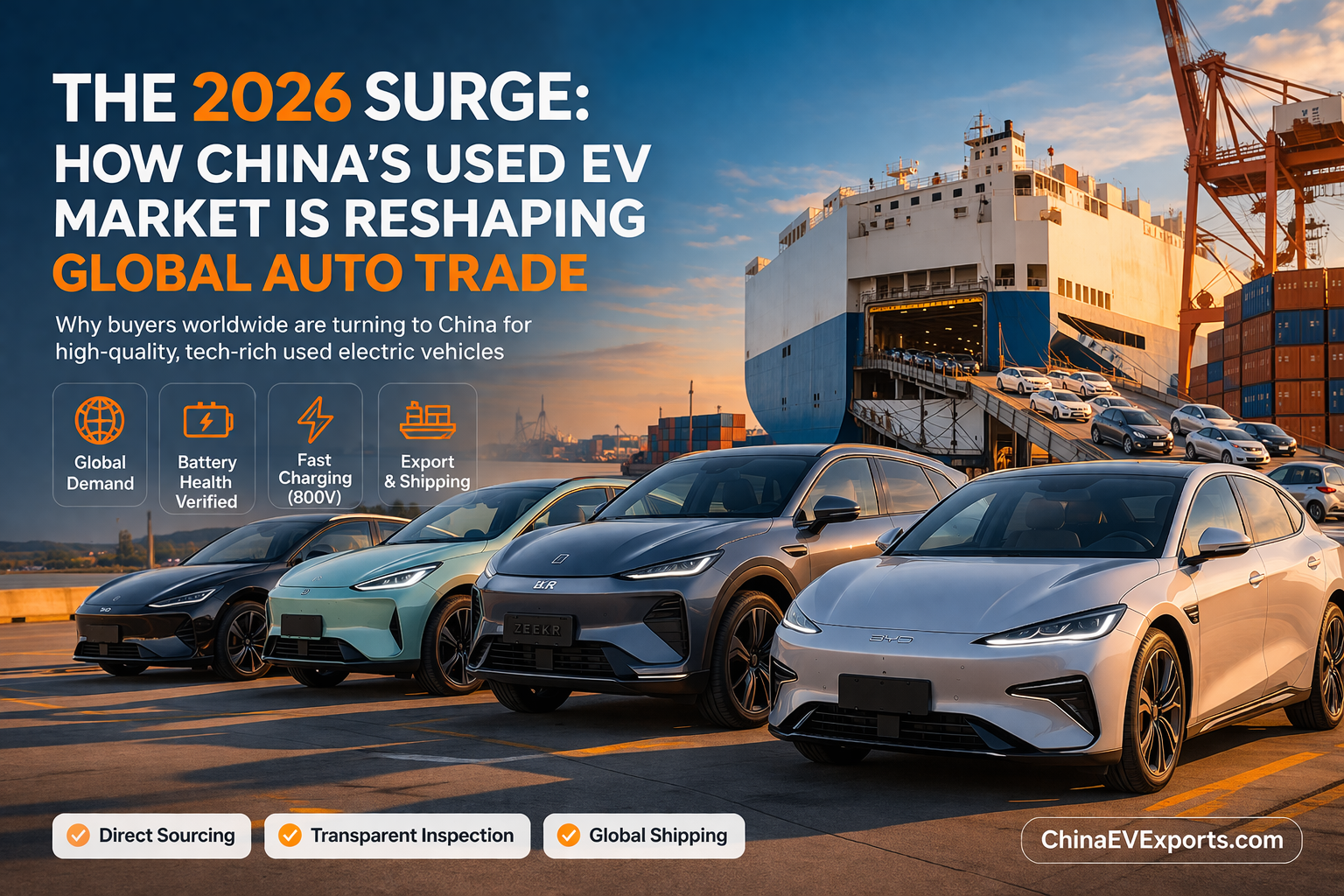
By 2026, China has become the world’s leading supplier of used electric vehicles (EVs), fueled by rapid domestic upgrade cycles and strong overseas demand. Buyers in regions such as the Middle East, Southeast Asia, and Eastern Europe are increasingly turning to Chinese EVs for their advanced battery systems, fast-charging capabilities, and significant cost advantages. Platforms like ChinaEVExports.com are simplifying access through standardized inspections and transparent battery data.
A New Phase in the Global EV Market
The global automotive industry has entered a new phase in 2026. The first large wave of electric vehicles sold between 2022 and 2024 is now transitioning into the secondary market. This shift has created an unprecedented supply of relatively new, technology-rich used EVs.
China, already the largest producer of electric vehicles, is now leading in exports of used EVs. For international importers, the conversation has evolved. Instead of questioning product reliability, buyers are now focused on securing supply quickly and efficiently.
This transition marks a key turning point: used EVs are no longer seen as a compromise, but as a strategic opportunity.
Rising Demand Across Key Global Regions
Middle East: Performance Under Extreme Conditions
Countries like the UAE and Saudi Arabia are seeing strong demand for premium Chinese EV models. One of the main reasons is climate adaptability.
Chinese manufacturers have optimized battery thermal management systems to perform in both high heat and cold environments. This makes them particularly suitable for desert climates, where older EV models from other regions may struggle with battery efficiency and degradation.
As a result, used high-end EVs are becoming a practical and cost-effective alternative to new imports.
Russia and Central Asia: Flexibility Matters
In colder regions, range anxiety and infrastructure gaps remain concerns. This is where extended-range electric vehicles (EREVs) are gaining traction.
Models that combine electric driving with a backup fuel-powered generator provide a hybrid solution. They offer the environmental benefits of EVs while maintaining reliability in extreme weather conditions and remote areas.
This balance has made them especially attractive in markets like Kazakhstan and Russia.
Southeast Asia: Infrastructure Alignment Driving Growth
Countries such as Thailand and Indonesia have made significant progress in aligning their charging infrastructure with international standards.
Compatibility with Chinese charging protocols has reduced barriers for imported EVs. Buyers no longer need complex modifications or adapters, making the ownership experience smoother and more affordable.
This “plug-and-use” compatibility is accelerating adoption across the region.
Why Used Chinese EVs Are No Longer “Second Choice”
The perception of used vehicles has changed significantly, especially in the EV sector. Several technological advancements are driving this shift:
1. Fast-Charging Architecture
Many vehicles entering the used market now feature high-voltage platforms. This allows ultra-fast charging, often reducing charging times dramatically compared to older systems.
Even after a few years of use, these vehicles remain competitive in terms of convenience and performance.
2. Battery Transparency and Data Tracking
Battery condition has always been a key concern for EV buyers. Today, detailed battery diagnostics provide clear insights into performance and lifespan.
Standardized reports—often including charge cycles and health indicators—allow buyers to make informed decisions with confidence.
3. Continuous Software Improvements
Unlike traditional vehicles, EVs benefit from over-the-air (OTA) updates. This means that software, user interface, and even performance features can improve over time.
A vehicle purchased used in 2026 may offer more functionality than when it was originally sold.
Cost Advantage: A Key Driver of Global Demand
Price remains one of the strongest factors behind the rise of used EV exports.
New electric vehicles typically experience significant depreciation in their early years. This creates an opportunity for second owners to acquire high-spec vehicles at substantially reduced prices.
In many cases, buyers can access advanced features—such as intelligent cockpit systems and extended driving range—at a fraction of the original cost.
At the same time, battery performance in modern EVs remains relatively stable, meaning buyers are not sacrificing reliability for savings.
Export Logistics: Faster and More Efficient Than Ever
One of the biggest improvements in recent years has been logistics.
Shipping used vehicles from China to international markets has become significantly more streamlined. Improved rail routes and dedicated vehicle shipping methods have reduced delivery times and increased reliability.
Today, international buyers can expect:
- Faster order processing
- More predictable shipping timelines
- Simplified export procedures
This efficiency makes cross-border sourcing more accessible, even for smaller dealers and independent buyers.
Common Questions from Buyers
Are Chinese EVs compatible with international charging networks?
Most export-ready vehicles are now designed to meet global charging standards or can easily be adapted. This ensures usability across different regions without major modifications.
How can buyers verify battery condition?
Battery diagnostics tools can directly access vehicle systems to generate detailed reports. These reports typically include key indicators such as battery health and usage history.
Why source directly from China?
Buying directly from the source market provides access to:
- A wider range of models
- More competitive pricing
- Reduced intermediary costs
This allows buyers to maximize value and maintain better control over inventory selection.
Final Thoughts: A Strategic Opportunity in 2026
The global shift toward electric mobility is accelerating, and the used EV segment is becoming an essential part of that transition.
With strong supply, improving technology, and growing international demand, 2026 represents a unique window of opportunity for importers and dealers.
Establishing reliable sourcing channels now can provide a long-term competitive advantage as the market continues to evolve.