
A Practical Guide for Dealers Looking for Margin, Technology, and Scale
Quick Overview (Featured Snippet Ready)
By 2026, the global automotive trade is undergoing a quiet but powerful transformation. What started as small-scale exports of used electric vehicles from China has rapidly evolved into a mainstream supply channel for international dealers.
Thanks to rapid innovation cycles from manufacturers like BYD, XPeng, and Xiaomi, lightly used Chinese EVs are now entering overseas markets with technology that often surpasses brand-new models in Europe and North America—at significantly lower cost.
For importers and distributors, this shift is not just about cheaper inventory. It’s about accessing better technology, stronger margins, and a more flexible supply chain through platforms like ChinaEVExports.com.
1. Why “Nearly New” Chinese EVs Are More Advanced Than You Think
In traditional fuel vehicles, a car that’s two years old is usually considered outdated. That logic doesn’t apply anymore in the EV space.
China’s EV industry moves fast—really fast.
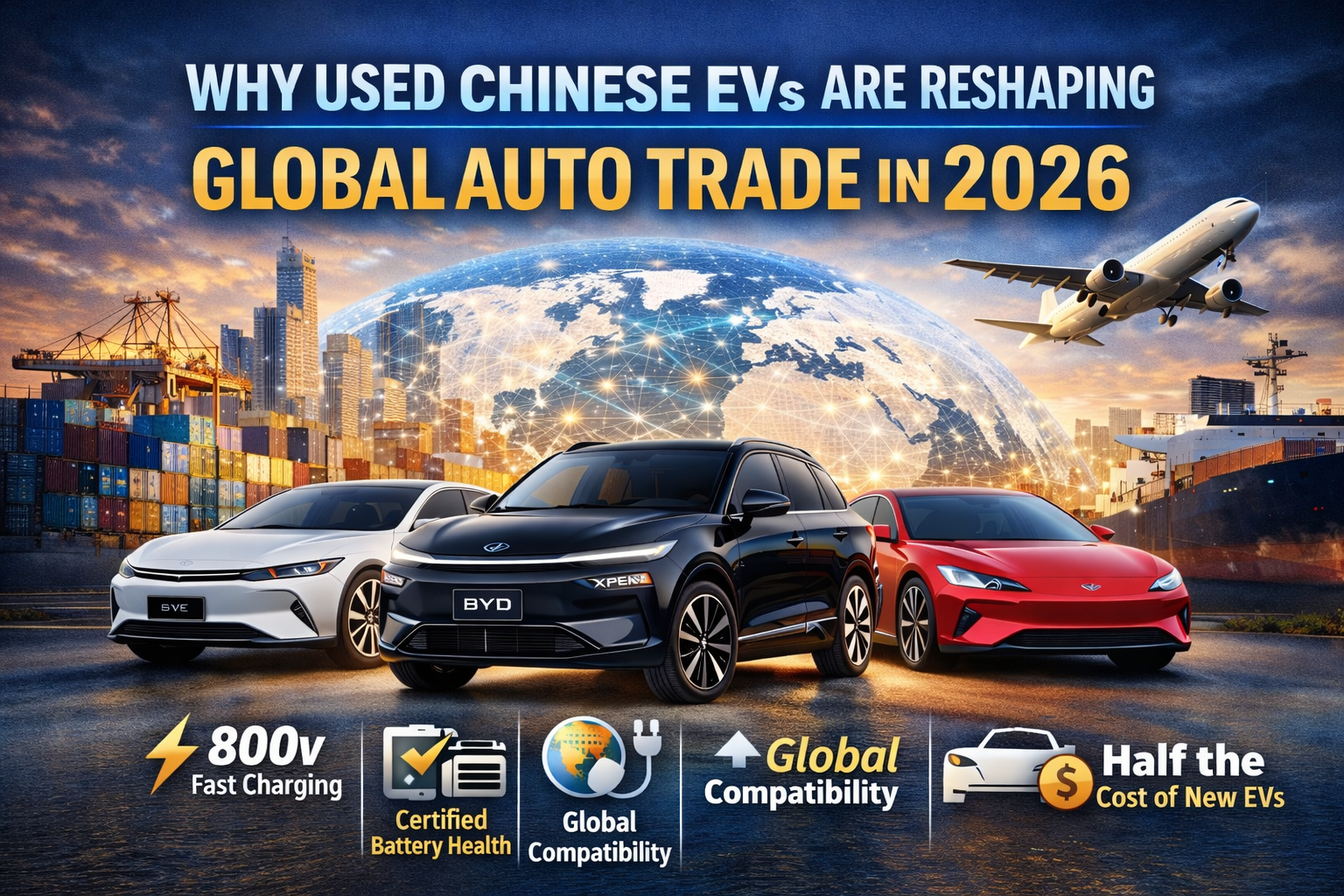
Vehicles produced in late 2024 and early 2025 were already built on next-generation 800V architectures using silicon carbide (SiC) technology. Meanwhile, many markets around the world are still operating on older 400V charging systems.
What does that mean in real-world use?
- Faster charging (often 10%–80% in under 20 minutes)
- Better thermal efficiency
- Improved driving performance and range stability
For dealers in regions like Southeast Asia or the Middle East, importing models such as the Xiaomi SU7 or XPeng G9 creates a strong competitive edge. You’re not just selling a used car—you’re offering future-ready technology that many local new cars still lack.
2. Battery Confidence: The Real Breakthrough Behind Used EV Growth
For years, one issue held back the used EV market globally: battery uncertainty.
Buyers simply didn’t trust the condition of second-hand batteries.
That problem has largely been solved in China.
Today, most export-ready vehicles come with standardized battery health documentation, often referred to as SOH (State of Health). Instead of relying on manual inspection, data is pulled directly from the vehicle’s Battery Management System (BMS), creating a far more accurate picture.
What serious buyers now expect:
- Verified battery health reports
- Historical charging data
- Clear capacity retention metrics
In particular, vehicles equipped with LFP (Lithium Iron Phosphate) batteries perform exceptionally well in the secondary market. These batteries degrade slowly and are known for long lifecycle performance.
A vehicle with 40,000–60,000 km on an LFP battery is typically still in excellent condition—often retaining over 90% of its original capacity.
For dealers, this level of transparency makes it much easier to build trust with end customers and close sales faster.
3. Infrastructure Compatibility Is No Longer a Barrier
One of the biggest challenges in early EV exports was compatibility—charging standards, software language, and system localization.
In 2026, this issue is far less significant.
Several key developments have made global distribution smoother:
Charging Standard Alignment
More countries are now supporting adapters or direct compatibility between Chinese GB/T systems and international CCS standards. This is especially true in fast-growing EV markets like:
- UAE
- Thailand
- Jordan
- Eastern Europe
Software Localization
Export-oriented vehicles now typically include multi-language systems out of the box. English is standard, with many models also supporting Arabic, Russian, and Spanish.
OTA Updates for Global Use
Many Chinese EV brands now push over-the-air updates tailored for overseas users, improving navigation, infotainment, and charging integration.
For importers, this means fewer post-sale headaches and a much smoother ownership experience for customers.
4. The Price Advantage: Where the Real Opportunity Lies
Let’s talk numbers—because this is where things get really interesting.
In 2026, the pricing gap between new EVs in Western markets and used Chinese EVs is still substantial.
Typical comparison:
- Entry-level new EV (Europe/US): $40,000–$50,000
- Used premium Chinese EV (1–2 years old): $20,000–$28,000
But the difference isn’t just price.
In many cases, the used Chinese EV offers:
- Longer driving range (often 600–700 km CLTC)
- Advanced driver assistance systems
- High-end interiors and infotainment
- Faster charging capability
For dealers, this creates a powerful value proposition.
Margins on used EV imports are often higher than traditional internal combustion vehicles, especially when sourced efficiently and sold in markets with growing EV demand.
5. Why Dealers Are Turning to China-Based Supply Platforms
Beyond the vehicles themselves, sourcing is becoming more professionalized.
Instead of relying on fragmented suppliers, more international buyers are working with specialized export platforms that offer:
- Pre-inspected inventory
- Verified battery reports
- Logistics and export support
- Consistent vehicle quality
This shift reduces risk and simplifies the buying process—especially for dealers entering the EV market for the first time.
Final Thoughts: A Structural Shift, Not a Temporary Trend
The rise of used Chinese EV exports isn’t a short-term opportunity—it’s a structural change in the global automotive supply chain.
Faster product cycles, better battery transparency, and improving infrastructure are all reinforcing this trend.
For forward-thinking dealers, the question is no longer “Should we explore this market?”
It’s “How fast can we integrate it into our business?”