
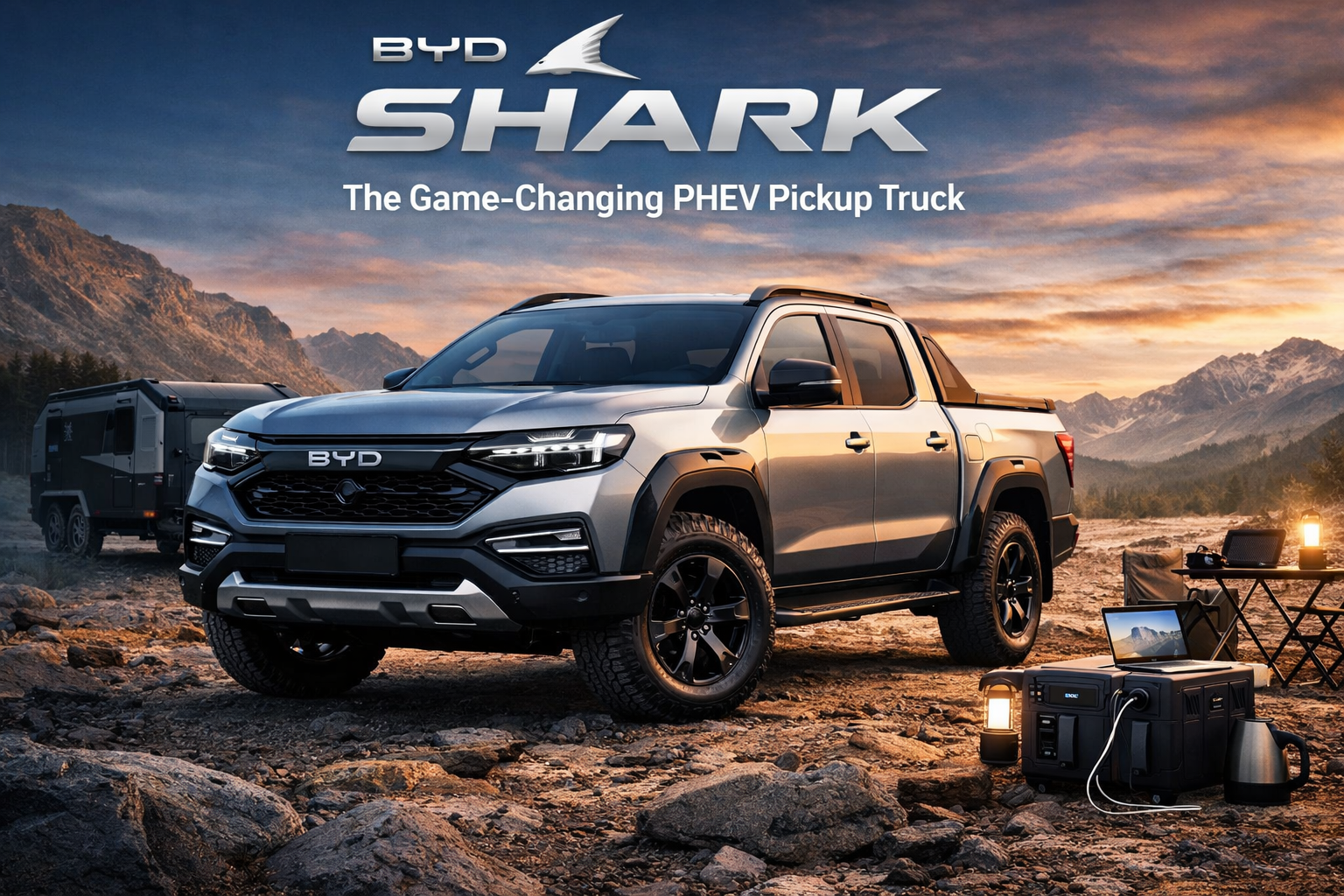
As global demand for electrified vehicles continues to expand beyond passenger cars, BYD is making a calculated move into one of the most competitive segments worldwide: pickup trucks. The debut of the BYD Shark signals more than just a new model—it reflects a strategic push into high-demand international markets where utility vehicles dominate.
For importers, distributors, and automotive businesses involved in China EV exports, the Shark represents a fresh category with strong commercial potential.
A New Architecture for Electrified Pickups
At the core of the BYD Shark is the brand’s DMO (Dual Mode Off-road) Super Hybrid platform. Unlike traditional ladder-frame pickups that prioritize durability over efficiency, this architecture blends electrification with off-road capability in a more integrated way.
The result is a vehicle designed to meet both commercial and lifestyle needs without the usual trade-offs seen in conventional pickups.
Key technological highlights:
- Plug-in Hybrid Powertrain (PHEV)
The combination of a turbocharged engine and dual electric motors allows the Shark to deliver strong torque while maintaining fuel efficiency. It also reduces dependence on charging infrastructure—an important factor in emerging markets. - Cell-to-Chassis (CTC) Integration
BYD integrates the battery directly into the vehicle structure, improving rigidity, safety, and overall weight distribution. - Electric All-Wheel Drive System
Unlike mechanical 4WD setups, the dual-motor configuration enables faster and more precise torque delivery, especially useful in off-road or variable terrain conditions.
Performance and Practical Capabilities
Although full specifications may vary by region, early data positions the BYD Shark as a serious competitor in the mid-to-high-end pickup segment.
- Power Output: Over 350 kW combined
- Electric Range: Up to 100 km (NEDC)
- Total Driving Range: Approximately 840 km
- Towing Capacity: Around 2,500 kg
- V2L Functionality: Supports external power supply for tools and outdoor use
This combination makes the Shark suitable not only for daily commuting but also for long-distance travel, work applications, and recreational activities.
Why BYD Is Launching Overseas First
Interestingly, BYD chose to debut the Shark outside China, starting with Mexico. This reflects a broader “glocalization” strategy—designing and launching vehicles specifically for overseas demand rather than adapting domestic models.
Target regions include:
- Latin America (Mexico, Brazil)
- Southeast Asia (Thailand, Indonesia)
- Australia
- Middle East (potential expansion)
These markets share two important characteristics: a strong pickup culture and increasing openness to electrified vehicles.
In the long term, BYD may leverage its growing international production network—such as facilities in Thailand and Brazil—to localize manufacturing and reduce costs.
Competitive Positioning: A Different Value Proposition
The BYD Shark enters a segment long dominated by models like the Toyota Hilux and Ford Ranger. Instead of competing purely on durability or brand legacy, BYD is introducing a different value equation.
Where the Shark stands out:
- Lower operating costs compared to diesel pickups
- Instant torque delivery from electric motors
- Advanced in-cabin technology and connectivity
- Multi-use functionality (work + lifestyle + outdoor scenarios)
For buyers, this shifts the decision from “traditional vs reliable” to “efficient vs future-ready.”
What This Means for EV Export Businesses
For companies involved in exporting Chinese EVs, the BYD Shark opens up a new segment that was previously difficult to penetrate.
Instead of focusing only on sedans and SUVs, exporters can now target:
- Commercial fleet buyers
- Construction and utility businesses
- Outdoor and adventure consumers
- Pickup-heavy regional markets
This diversification could significantly expand addressable demand.
Final Thoughts
The BYD Shark is not just another product launch—it represents a broader shift in how electrification is entering traditionally conservative vehicle segments.
If BYD can deliver competitive pricing and reliable supply, the Shark has the potential to reshape expectations in global pickup markets.
For now, key details such as regional pricing and delivery timelines are still emerging. But one thing is clear: this is a model worth watching closely if you’re involved in the evolving landscape of China EV exports.